
Hosting My First Hackathon As A Developer Community Manager (Part I)
The how, a report and recommendations.


I’ve known Daniel for a year now. We met at API Conf 2025 when he stopped by our booth to ask about our community, APIs and services we offer. We struck a conversation, talked about a possible partnership and exchanged contacts.
A lot of people got my contact at that event but somehow, Daniel’s was the only one I saved. I knew we’d work together. Knew we’d end up being friends.
The supposed partnership that led to us exchanging contacts eventually didn’t happen but our friendship did. In the same year, he became Enyata’s Community Manager, a role another friend held before Daniel.
I wanted to host a hackathon for Interswitch Developer Community. My goal was to use that to get more granular, solid feedback for my product and engineering team so we can improve our developer tools and to improve adoption.
For Enyata, their relationship with the Nigerian tech ecosystem runs deeper than software. For years, the Enyata Community, a CSR initiative of Enyata, has shown up for the ecosystem in tangible ways. Between 2021- 2023, that looked like distributing 50 MacBooks to developers across the country. In 2024, they held an edition of the Buildathon with over 500 participants and financial incentives given to winners.
In late 2024, Enyata decided to bring it back and go bigger. The reason was simple: a gap. Across the Nigerian tech ecosystem, there’s a visible divide between newcomers trying to break in and mid-to-senior level engineers with real-world experience. Many early-stage developers lack hands-on engineering exposure and specifically, experience integrating production-grade APIs into real products. That kind of knowledge doesn’t come from tutorials or courses. It comes from building something that has to actually work.
Daniel told me that Interswitch made sense as a partner almost immediately. As one of Africa’s leading financial technology companies, Interswitch has a broad suite of APIs spanning multiple industries — payments, identity, health, agriculture, and more. Combining that infrastructure with Enyata’s community reach felt like a natural fit.
So we started the conversation.
Part A: Planning and Registration
We mapped out the concept and built the initial plan in October and November 2025. The goal of getting 1,000 developers to participate felt audacious. I mean, it was going to be my first ever hackathon. I didn’t know if I could do it but we decided to go for it anyway.
Publicity
We shot a video at Enyata’s HQ outlining everything participants needed to get started. What we didn’t anticipate was how widely it would travel, specifically on WhatsApp.
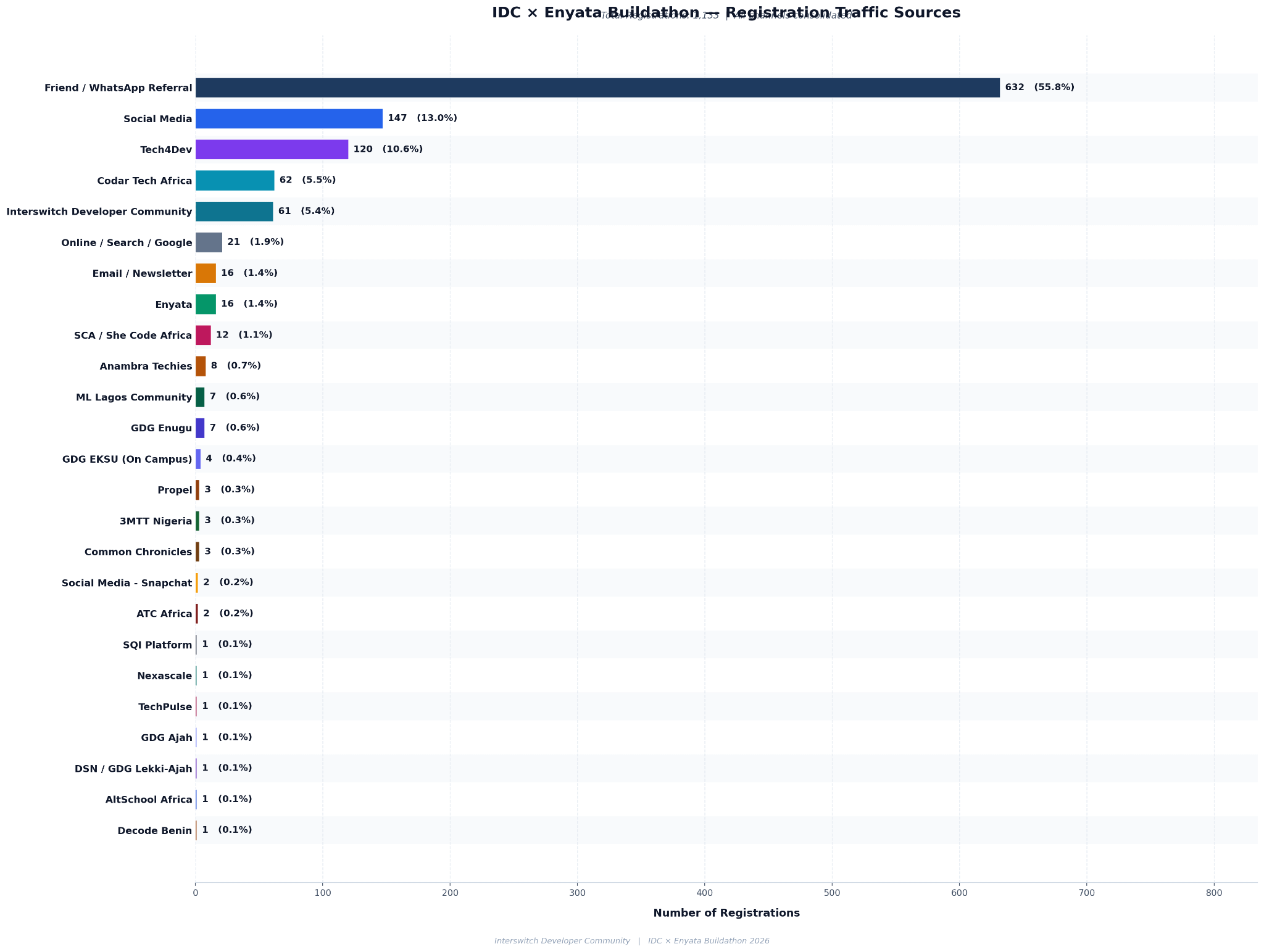
We used Claude to analyse where registration traffic came from (we had a ‘how did you hear about this hackathon?’ field on the registration page), and WhatsApp ranked number one. The top source, ‘friends and family,’ was almost entirely driven by WhatsApp - people sharing through status updates, peer groups, and informal community chats.
That was a genuine surprise. WhatsApp, despite being informal, delivered our best results. Probably because people trust recommendations from their own circles more than anything an organisation can broadcast. Word of mouth wins again. Another unexpected one was Snapchat. We genuinely did not see that coming.
Building Community Partnerships
Because we didn’t have an advertising budget, we knew we had to go beyond our own communities. Most developers in Nigeria belong to at least one community - formal or informal. Enyata has a community of 7k+, Interswitch has about the same. We were aware that not everyone from our communities might want to be a part of it so we decided to go beyond our communities and numbers.
We did warm outreaches - community leads we knew personally, had worked with in the past, or were already in WhatsApp groups with. I had spent time at Propel working with over 200 African communities and still had strong relationships from that season. Combined with Daniel’s network, we had a solid starting list.
We built a tracker to stay on top of who we were speaking to, the status of each conversation, what needed to happen next, and who was responsible. We put together pitch decks (Claude and Manus helped significantly here, alongside Canva for the visual execution), reached out directly, held introductory calls, and invited communities to come on board as partners.
What we were building was for the ecosystem, so it made sense to build it with the ecosystem. The partners we brought on board weren’t just amplifiers — they were stakeholders in the outcome. We’re genuinely grateful to Codar Tech, Nexascale, Technoville, She Code Africa, Anambra Techies, Propel, ML Lagos, Tech4Dev, GDG Enugu, and ATC Africa for showing up the way they did. Not to sound shout-out-ish but I’m thankful to my friends - Samuel, Kabari, Onyewuchi, Soibi, Seyi, Folakemi- for posting this on their status as many times as they wanted to. Y’aall rock!
Registration and Hitting the Target
Enyata handled the registration infrastructure, building the hackathon website and managing email communications. During the preparation phase, I mostly handled correspondence for outbound emails and managed support for registration issues: team codes, undelivered confirmation emails, and similar hiccups, all of that shebang.
When we didn’t hit our 1,000 target by March 6th, we extended the deadline. We honestly didn’t know whether it would work. Our approach was simple: try everything. More posts across social media, direct outreaches and reminders to community partners, and a referral campaign in my community where anyone who brought in 10 registrations earned a gift box. The campaign didn’t directly impact registration count but by March 20th, we exceeded our target closing at 1,187 registrations and over 500 teams formed.
Welldone Zurum! You do so much and you do them really well, I'm in awe of your strength and commitment and this is inspiring ❤️